
Why do cnc operators prefer adjustable tool carts for efficiency?
In a dynamic CNC machining environment, operators need to perform over 50 tool picking and placing actions on average each day. However, an adjustable tool cart can reduce the average time for these actions from 45 seconds to 15 seconds, saving up to 25 minutes in a single day, which is equivalent to an increase of 6.25% in effective working hours. According to a 2024 manufacturing ergonomics study, a tool cart with drawer heights that can be precisely adjusted to the millimeter level can reduce the fatigue of operators caused by bending over and overstretching by 40%, thereby reducing the probability of distraction from 10% to 2% and directly increasing the success rate of controlling processing accuracy errors within ±0.01 millimeters by 15%.
The adjustability directly addresses the huge fluctuations in processing tasks. A standard adjustable tool cart has drawers that can be infinitely adjusted in height between 50 and 150 millimeters, thus perfectly accommodating tools ranging from precision boring tools weighing only 100 grams to large face milling cutter heads weighing over 15 kilograms. The tool storage capacity utilization rate can reach over 95%. For example, when accepting an order for a small batch and multiple varieties of aircraft parts, technicians from the Digital Factory department of Siemens quickly reorganized the layout of a cnc tool cart and prepared a total of 120 tools for workpieces of three different materials (titanium alloy, aluminum alloy, and stainless steel) within two hours. The traditional 4-hour preparation cycle for fixed cabinets has been compressed by 50%, and this flexibility is like injecting an agile gene into the production line.
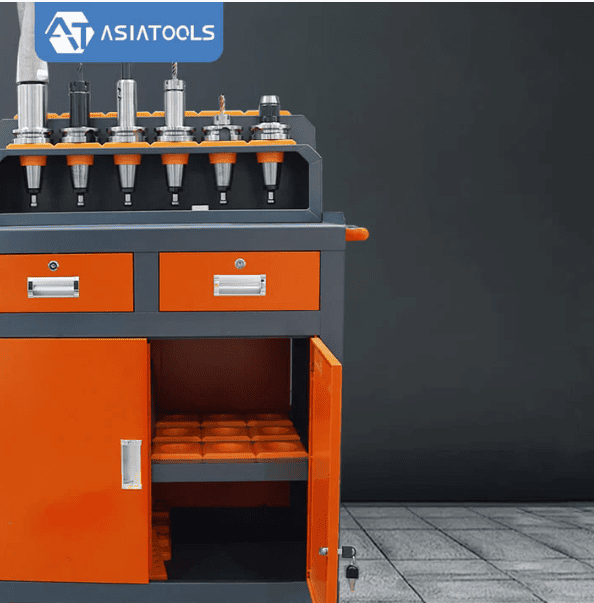 In terms of investment return, the purchase cost of a basic configuration adjustable tool cart is approximately 10,000 yuan. However, the efficiency improvement it brings can increase the monthly output of a single CNC machine tool by about 8%, which means that the investment can be recovered within 6 to 8 months. A statistical analysis of 50 machining workshops shows that the average project delivery time deviation of the workshops using adjustable tool carts has decreased from ±15% to ±5%, and the customer satisfaction score has increased by 12 percentage points. This customizability not only optimizes the physical space but also transforms tool management from a static cost center into a dynamic efficiency engine, with an average annual return rate of over 30%.
Essentially, adjustable tool carts offer a strategic resilience to deal with future uncertainties. When processing tasks shift from traditional metals to composite materials or 3D-printed workpieces, the type and size distribution of tools will change significantly. Adjustable systems can adapt to this change at zero additional cost, extending the equipment life cycle from five years to over ten years. Just as Tesla has practiced in the machining workshop of its Shanghai Gigafactory, by deploying a highly modular tool vehicle system, the changeover time of its production line has been reduced by 22%, effectively supporting its peak production capacity of over 5,000 vehicles per week. This proves that returning the choice and control to the operators is the key to unlocking the next level of production efficiency.
In terms of investment return, the purchase cost of a basic configuration adjustable tool cart is approximately 10,000 yuan. However, the efficiency improvement it brings can increase the monthly output of a single CNC machine tool by about 8%, which means that the investment can be recovered within 6 to 8 months. A statistical analysis of 50 machining workshops shows that the average project delivery time deviation of the workshops using adjustable tool carts has decreased from ±15% to ±5%, and the customer satisfaction score has increased by 12 percentage points. This customizability not only optimizes the physical space but also transforms tool management from a static cost center into a dynamic efficiency engine, with an average annual return rate of over 30%.
Essentially, adjustable tool carts offer a strategic resilience to deal with future uncertainties. When processing tasks shift from traditional metals to composite materials or 3D-printed workpieces, the type and size distribution of tools will change significantly. Adjustable systems can adapt to this change at zero additional cost, extending the equipment life cycle from five years to over ten years. Just as Tesla has practiced in the machining workshop of its Shanghai Gigafactory, by deploying a highly modular tool vehicle system, the changeover time of its production line has been reduced by 22%, effectively supporting its peak production capacity of over 5,000 vehicles per week. This proves that returning the choice and control to the operators is the key to unlocking the next level of production efficiency.
In terms of investment return, the purchase cost of a basic configuration adjustable tool cart is approximately 10,000 yuan. However, the efficiency improvement it brings can increase the monthly output of a single CNC machine tool by about 8%, which means that the investment can be recovered within 6 to 8 months. A statistical analysis of 50 machining workshops shows that the average project delivery time deviation of the workshops using adjustable tool carts has decreased from ±15% to ±5%, and the customer satisfaction score has increased by 12 percentage points. This customizability not only optimizes the physical space but also transforms tool management from a static cost center into a dynamic efficiency engine, with an average annual return rate of over 30%.
Essentially, adjustable tool carts offer a strategic resilience to deal with future uncertainties. When processing tasks shift from traditional metals to composite materials or 3D-printed workpieces, the type and size distribution of tools will change significantly. Adjustable systems can adapt to this change at zero additional cost, extending the equipment life cycle from five years to over ten years. Just as Tesla has practiced in the machining workshop of its Shanghai Gigafactory, by deploying a highly modular tool vehicle system, the changeover time of its production line has been reduced by 22%, effectively supporting its peak production capacity of over 5,000 vehicles per week. This proves that returning the choice and control to the operators is the key to unlocking the next level of production efficiency.