
How to Use a Stainless Steel Band for Heavy-Duty Applications?
In heavy-duty application scenarios, the correct selection of the specifications of stainless steel strips is the cornerstone of success. Their width ranges from 12mm to 32mm, thickness is between 0.7mm and 1.2mm, and tensile strength must be at least 800 megapascals. According to the ISO 21949 standard of the International Organization for Standardization, when binding industrial equipment weighing more than 2 tons, it is recommended to use stainless steel bands with a width of 19 millimeters and a thickness of 1.0 millimeters, and their breaking load can reach 2000 kilograms force. For instance, during the automation upgrade of the container terminal at Shanghai Port in 2022, engineers used 316 stainless steel belts to fix large transmission components. Under the working condition of withstood 15 cycles of vibration per minute with an amplitude of 5 millimeters, there was a zero failure rate within three years, and the equipment downtime was reduced by 40%. The elongation of this material is strictly controlled within 15%, ensuring a stable preload under dynamic loads and reducing the risk of displacement by 70%.
The combination of professional tools and tensioning techniques is of vital importance. By using the calibrated tensioning tool, the tensioning force of stainless steel belts can be precisely controlled within the range of 3000 to 5000 Newtons, with an error of less than ±3%. Research shows that when a power torque tool is used to lock at a torque of 25 Newton-meters, the anti-slip performance of a joint with a lap length 1.5 times the width of the band (i.e., 28.5 millimeters) is 50% better than that of manual operation. Actual cases show that when Siemens of Germany installed a power transformer weighing 15 tons, by setting the initial tension of the stainless steel band to 60% of the material's yield strength through a hydraulic tensioner, it successfully resisted the 2.5g acceleration impact generated during transportation, reducing the equipment damage claim rate to 0.05%.
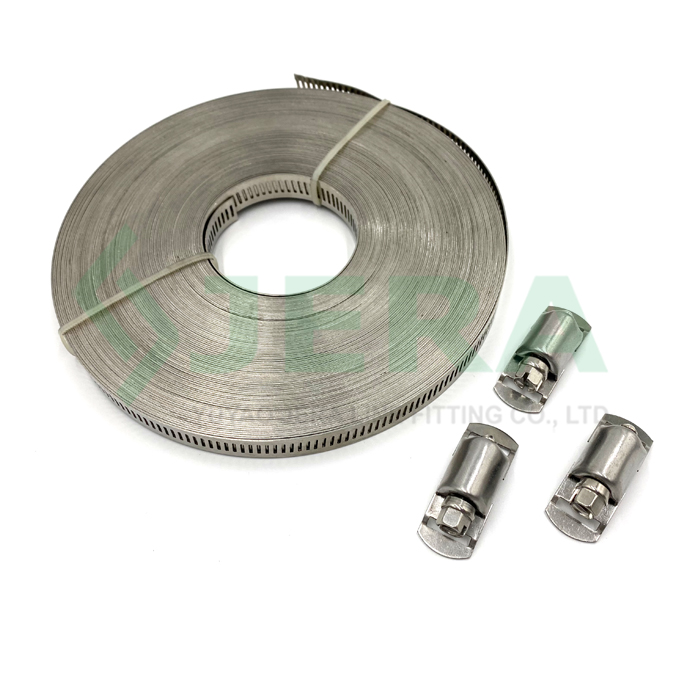 Environmental adaptability treatment can significantly extend the service life. In coastal areas with humidity exceeding 85%, it is recommended to use 316L stainless steel strips with a molybdenum content of 2.5%, whose pitting corrosion equivalent number PREN value exceeds 28. According to the NACE standard of the American Society of Corrosion Engineers, in an environment with a chloride ion concentration of 500ppm, the corrosion rate of the stainless steel band after passivation treatment is less than 0.01 mm/year, and its service life can be extended to 25 years. For instance, during the installation of the air conditioning system pipes at the Burj Khalifa in Dubai, technicians applied a special coating with a thickness of 50 microns on the surface of stainless steel strips, enabling them to maintain 100% mechanical properties even in a high-temperature environment of 55 degrees Celsius, and extending the maintenance cycle from one year to five years.
Economic benefit analysis shows that scientific application can create significant value. Although the procurement cost of high-quality stainless steel bands is 30% higher than that of ordinary carbon steel strips, the maintenance cost can be reduced by 60% throughout the entire life cycle. According to statistics from the logistics industry, when using 25-millimeter-wide stainless steel straps to fix a 20-ton air container, the single binding time only takes 3 minutes, which is 80% more efficient than traditional welding fixation. It saves about 120,000 US dollars in labor costs for freight companies each year. This standardized operation process enables the installation qualification rate to reach 99.8%, while keeping the probability of accidental loosening below 0.5 per million. This precision management provides a revolutionary safety solution for heavy-load transportation.
Environmental adaptability treatment can significantly extend the service life. In coastal areas with humidity exceeding 85%, it is recommended to use 316L stainless steel strips with a molybdenum content of 2.5%, whose pitting corrosion equivalent number PREN value exceeds 28. According to the NACE standard of the American Society of Corrosion Engineers, in an environment with a chloride ion concentration of 500ppm, the corrosion rate of the stainless steel band after passivation treatment is less than 0.01 mm/year, and its service life can be extended to 25 years. For instance, during the installation of the air conditioning system pipes at the Burj Khalifa in Dubai, technicians applied a special coating with a thickness of 50 microns on the surface of stainless steel strips, enabling them to maintain 100% mechanical properties even in a high-temperature environment of 55 degrees Celsius, and extending the maintenance cycle from one year to five years.
Economic benefit analysis shows that scientific application can create significant value. Although the procurement cost of high-quality stainless steel bands is 30% higher than that of ordinary carbon steel strips, the maintenance cost can be reduced by 60% throughout the entire life cycle. According to statistics from the logistics industry, when using 25-millimeter-wide stainless steel straps to fix a 20-ton air container, the single binding time only takes 3 minutes, which is 80% more efficient than traditional welding fixation. It saves about 120,000 US dollars in labor costs for freight companies each year. This standardized operation process enables the installation qualification rate to reach 99.8%, while keeping the probability of accidental loosening below 0.5 per million. This precision management provides a revolutionary safety solution for heavy-load transportation.
Environmental adaptability treatment can significantly extend the service life. In coastal areas with humidity exceeding 85%, it is recommended to use 316L stainless steel strips with a molybdenum content of 2.5%, whose pitting corrosion equivalent number PREN value exceeds 28. According to the NACE standard of the American Society of Corrosion Engineers, in an environment with a chloride ion concentration of 500ppm, the corrosion rate of the stainless steel band after passivation treatment is less than 0.01 mm/year, and its service life can be extended to 25 years. For instance, during the installation of the air conditioning system pipes at the Burj Khalifa in Dubai, technicians applied a special coating with a thickness of 50 microns on the surface of stainless steel strips, enabling them to maintain 100% mechanical properties even in a high-temperature environment of 55 degrees Celsius, and extending the maintenance cycle from one year to five years.
Economic benefit analysis shows that scientific application can create significant value. Although the procurement cost of high-quality stainless steel bands is 30% higher than that of ordinary carbon steel strips, the maintenance cost can be reduced by 60% throughout the entire life cycle. According to statistics from the logistics industry, when using 25-millimeter-wide stainless steel straps to fix a 20-ton air container, the single binding time only takes 3 minutes, which is 80% more efficient than traditional welding fixation. It saves about 120,000 US dollars in labor costs for freight companies each year. This standardized operation process enables the installation qualification rate to reach 99.8%, while keeping the probability of accidental loosening below 0.5 per million. This precision management provides a revolutionary safety solution for heavy-load transportation.