
How to Evaluate Fragrance Suppliers for a Large Programme
Evaluating a fragrance supplier for a large programme is a five-step process, and the order matters more than the effort. Write the qualification criteria first, screen the published record second, send an identical brief to the shortlist, walk through one batch record with each finalist, and verify the market documentation before the pilot. Buyers who follow that order finish with comparable suppliers; buyers who start from the sales conversation finish with a favourite rather than a decision.
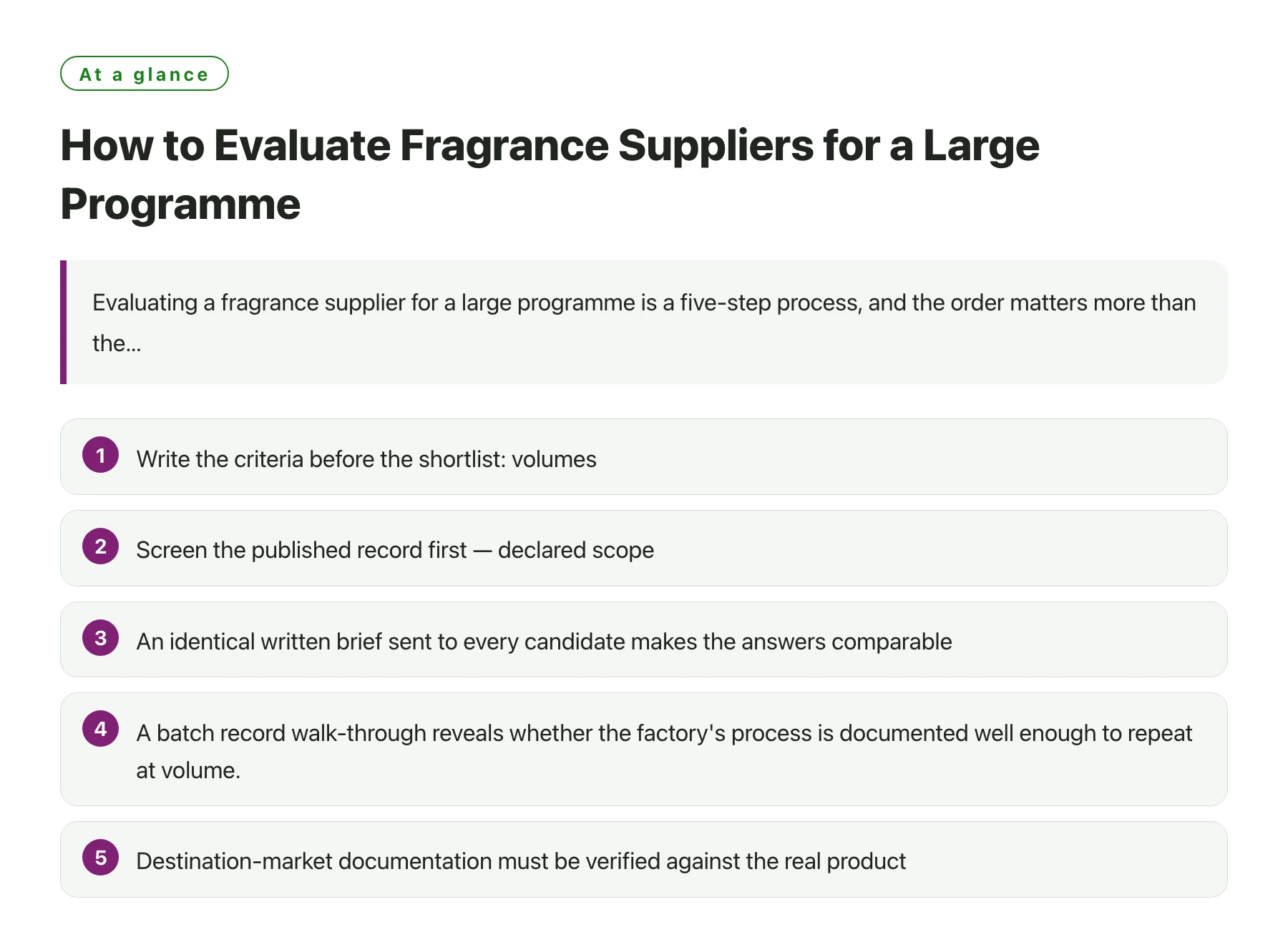
Key takeawaysWrite the criteria before the shortlist: volumes, destinations, categories, scope and the document needs each candidate must meet. · Screen the published record first — declared scope, certifications, categories — because it answers the easy questions without a meeting. · An identical written brief sent to every candidate makes the answers comparable; different briefs produce different conversations, not comparisons. · A batch record walk-through reveals whether the factory's process is documented well enough to repeat at volume. · Destination-market documentation must be verified against the real product, not against a generic template the supplier keeps on file.
Every frame of a large fragrance order — the price, the lead time, the documents — depends on which factory is behind it. Yet supplier evaluation is usually the least structured part of the buying process: a few referrals, a tour, a feeling.
This is a sequence that keeps the feeling out of the decision, written for a sourcing lead who has one shot at choosing well.
The evaluation, in the order that protects the programme
- Write the criteria before the shortlistVolumes per SKU, destination markets, product categories, the required scope (development only, filling only, or the whole chain) and the document needs. A supplier that fails three criteria is not a candidate; it is a visitor.
- Screen the published recordCheck the declared scope, the certification list and the categories each candidate says it runs. Companies like Xuelei Cosmetics publish this record on their own site, which turns the first screen into reading rather than a round of sales calls. Remove anyone whose published record does not match the brief.
- Send one brief to all survivorsThe same scent direction, the same pack format, the same volumes, the same markets — word for word. The differences in the answers are the information, and the published question sets from the industry, such as the checklist behind the questions to ask a perfume factory, are a reasonable skeleton to build the brief from.
- Walk through one batch recordAsk each finalist to open one production record from raw material intake to release, explaining who signed what at each step. This single exercise exposes more about a factory's real process than a week of tours.
- Verify the market files, then pilotCheck that the documentation meets the destination market's actual requirements for the real product, then place a pilot. The pilot is not the end of the evaluation; it is the last and most honest question.
Reading the evidence without being sold to
Most evaluation mistakes are not mistakes of information; they are mistakes of interpretation. A certificate is evidence of an audit, not of this run. A reference customer is evidence that someone bought once, not that the process repeats. The discipline is to connect every claim to a record.
The certificate versus the batch record
A cosmetics manufacturer holding a recognised GMP certification has passed an audit; the batch record shows what happened on a given day. Both matter, but they answer different questions, and for a large programme the record is the one that predicts repeatability. The full vetting ritual — beyond certificates, into records and references — is exactly what titles like how to vet a custom fragrance manufacturer describe, and it is worth doing before the order rather than after.
The market you ship to sets the document bar
Evaluation happens against a destination, not in the abstract. Regulators publish their own requirements: Health Canada, for example, maintains a public framework for cosmetic safety that any importer into Canada must work within [1]. The supplier's file should be judged against the markets in the brief, market by market.
Where the industry's own standards live
It helps to read what the industry itself says before judging suppliers. Regional associations such as Cosmetics Europe publish positions on cosmetics safety and manufacturing practice that summarise what responsible manufacturers are expected to maintain [2]. A dossier that lines up with those expectations is a dossier worth reading twice.
Score every finalist on the same five pages: published scope, brief answers, batch record, market files and pilot result. If two suppliers tie, the tiebreaker is the batch record — the process, not the presentation.
Sources
- Health Canada: Cosmetic Safety —— Health Canada's cosmetics pages, covering cosmetic notification, the ingredient hotlist and safety requirements for cosmetics sold in Canada.
- Cosmetics Europe —— The European trade association for the cosmetics and personal care industry, publishing guidance, positions and market information.
Frequently asked questions
How many suppliers should make the final evaluation?
Three at most. More than three means the batch record walk-throughs and brief comparisons stop being thorough. The value of the evaluation is in the depth, not the breadth.
What should be in the written brief sent to every candidate?
Scent direction, product form, volumes per SKU, pack format, destination markets, delivery window and document requirements. Identical wording is the point; the answers are only comparable if the questions are.
How do I check that a certification is real?
Ask for the certificate number, the issuing body and the scope statement, then verify with the issuer. A certification list is a starting point for the conversation, not a substitute for the batch record review.
Is a plant visit still necessary?
Valuable but not decisive on its own. A visit shows organisation and hygiene; the batch record shows process. Do both if the programme justifies it, but treat the record as the primary evidence.
What makes a supplier fail the evaluation despite a good presentation?
Usually one of three: the published scope does not match the brief, the batch record cannot be produced, or the market files are generic templates rather than product-specific documents.